Self-healing thermoset composites
Mechanical testing and characterization of a new class of intrinsically self-mendable thermoset polymers. Published in Polymer (2017) with Lisha Zhang and Henry Sodano.
Overview
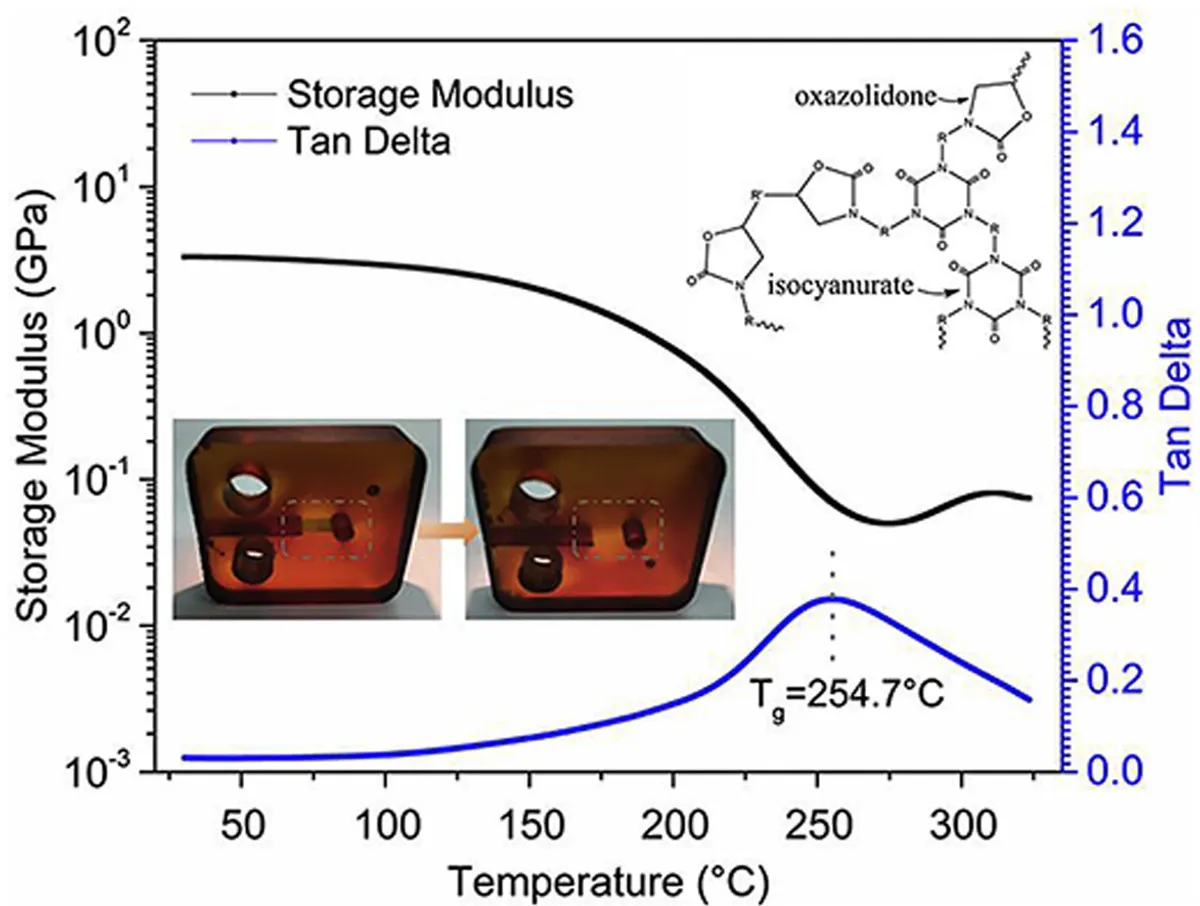
A new class of intrinsically self-mendable thermoset polymers built on an isocyanurate-oxazolidone (ISOX) network — the first demonstration of an isocyanurate ring as a repairing moiety. Mechanical stress at a crack drives cycloreversion of the rings, generating reactive free isocyanates at the fracture surface; thermal annealing re-trimerizes them, recovering fracture toughness.
The polymers achieve a glass transition temperature of 270 °C and onset decomposition temperature of 365 °C — the highest reported for an intrinsically healable thermoset — while keeping mechanical properties (Young’s modulus ~3 GPa, tensile strength 65 MPa at 125 °C) comparable to engineering-grade epoxies. First-cycle mending efficiency reached ~51% under macroscopic crack conditions.
My contribution: mechanical testing and characterization across different Toluene Diisocyanate / Diglycidyl Ether of Bisphenol F (TDI/DGEBF) formulations to quantify healing performance. Published in Polymer (2017) with Lisha Zhang and Henry Sodano as co-authors.